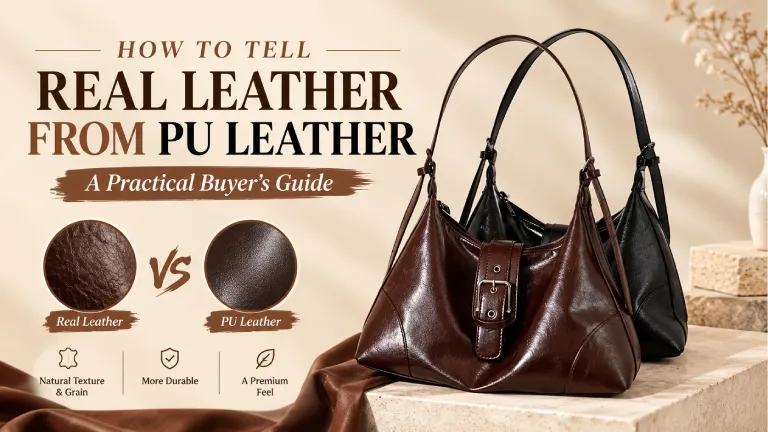
Why Knowing How to Tell Real Leather Matters
Shoppers search for how to tell real leather because labels and product descriptions can be confusing, and prices do not always reveal what you are buying. A bag marked “leather” might be full-grain hide, split leather with a coating, bonded leather made from scraps, or a polyurethane imitation. Each behaves differently, ages differently and deserves a different price. Learning how to tell real leather from PU leather lets you pay fairly and choose the material that suits your life.
It also helps to remember that PU leather is not a scam. It is a legitimate material with real advantages, such as water resistance and lower cost. The problem only arises when a product is described misleadingly. If you want a broader comparison of the two materials, start with leather vs PU leather handbags and then return here for hands-on tests.
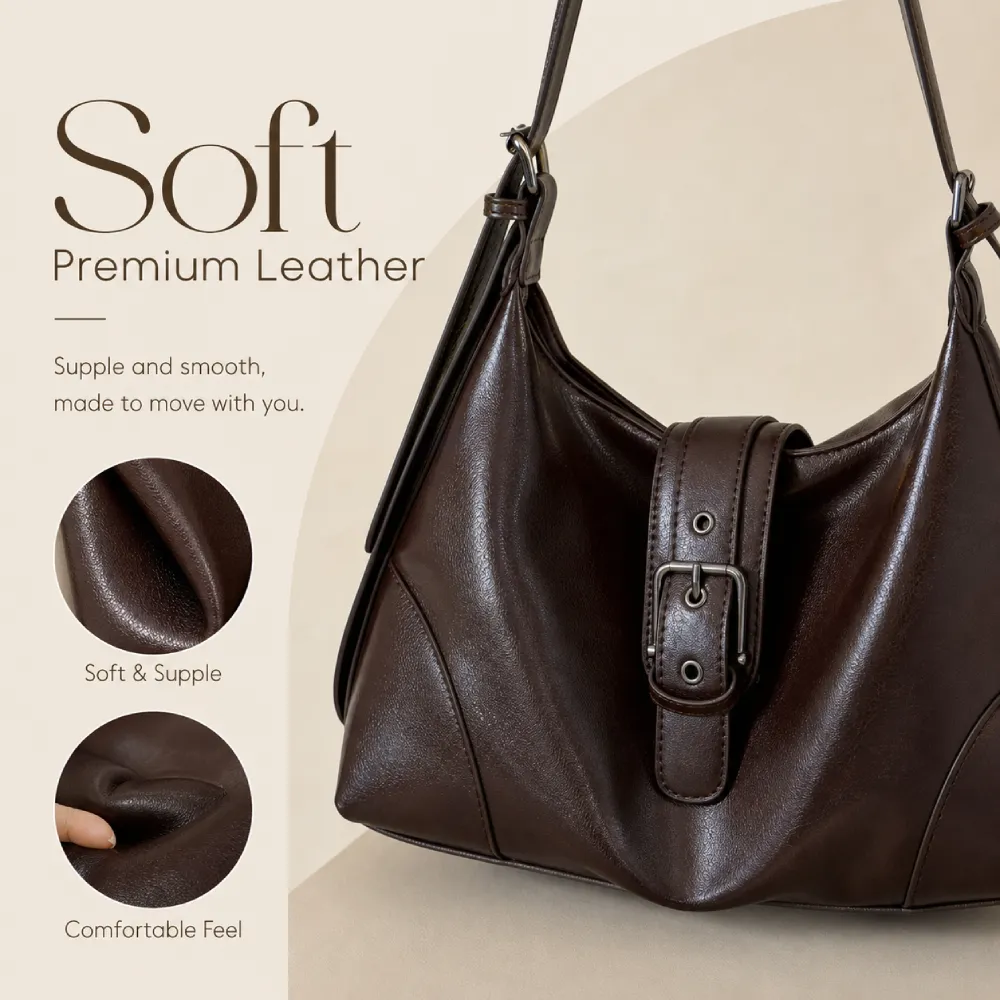
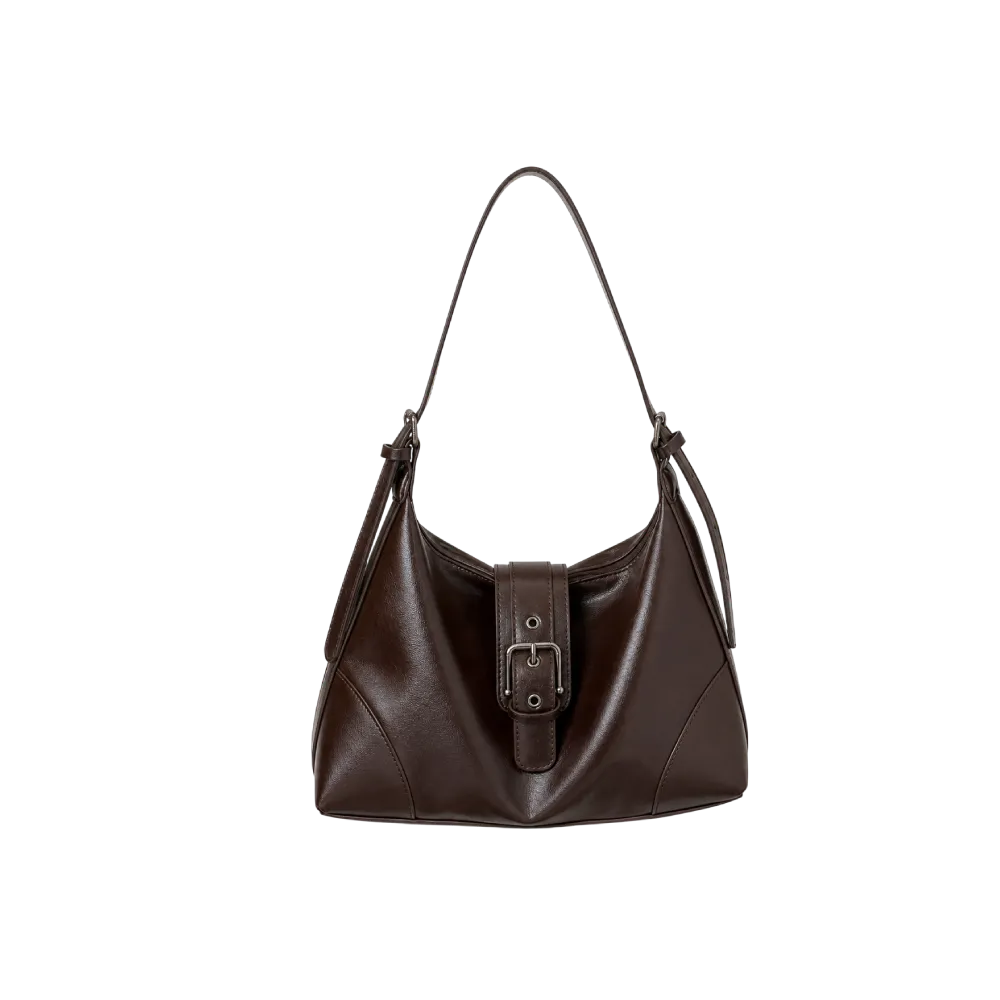
Crodar Vintage Shoulder Bag
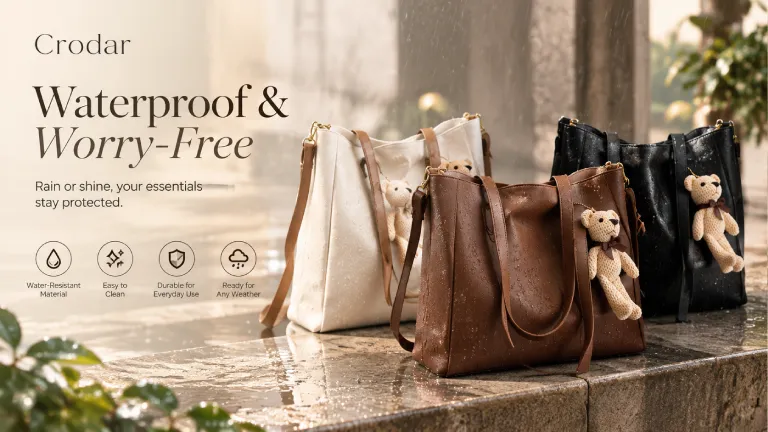
The Crodar Vintage Shoulder Bag combines timeless style with everyday functionality. Crafted from soft PU leather, this brown women’s shoulder bag features a vintage buckle design.
Start With the Label and the Price
The first step in how to tell real leather is reading the label carefully. Terms such as “genuine leather” sound premium but usually describe a lower grade of real hide. “Top-grain” and “full-grain” indicate better quality. Words like “vegan leather,” “faux leather,” “man-made material” or “PU” mean the product is synthetic. In the United States, the Federal Trade Commission publishes guidance on how leather and related products should be described, which you can explore through the FTC website.
Price is a clue, not proof. A large bag priced very low is unlikely to be full-grain leather, because real hide is costly to source and finish. At the same time, a high price does not guarantee quality. Our guide on designer vs budget handbags explains why brand markup can distort value, so always combine price with physical checks.
The Look Test: Grain and Edges
Real leather has natural variation. Look closely at the surface and you will see small irregularities, tiny pores and slight differences in grain from one area to another. PU leather is manufactured, so its embossed pattern tends to repeat perfectly. If you can spot an identical grain pattern across the whole bag, it is probably synthetic.
Examine the edges as well. Real leather edges usually look slightly rough, fibrous or painted, because the inside of the hide is a fibrous material. PU leather edges often show a plastic-like layer on top of a fabric backing, which can look smooth, flat and uniform. A cut edge or the inside of a seam is one of the most reliable places to check how to tell real leather without damaging the bag.
The Touch and Smell Test
Run your hand across the surface. Real leather feels warm, soft and slightly uneven, and it flexes in a natural, wrinkled way when you press it. PU leather tends to feel smooth, cool and uniform, and when you bend it, the surface often creases in sharp, plastic-looking lines rather than fine wrinkles.
Smell is another useful signal. Real leather has a distinctive earthy, natural scent, while PU leather often smells faintly chemical or like plastic. A strong, sharp chemical odor can indicate a low-quality coating. Smell can be misleading if the leather has been heavily treated, so use it alongside other checks rather than on its own.
The Water Drop and Flex Tests
A simple water test shows how the surface behaves. Place a tiny drop of water on an inconspicuous area. Real, untreated leather absorbs moisture slowly and may darken for a moment, while PU leather usually causes the water to bead and sit on top because the coating is waterproof. Many real leather bags are finished with protective coatings, so this test is not perfect, but it helps when combined with others.
The flex test is also revealing. Bend a small section of the bag. Real leather wrinkles in an organic way and returns to shape gradually, while PU may stretch smoothly or show shallow cracks over time. Do not damage a bag you do not own, but you can often gently press and flex the strap or a corner in a store.
What About Bonded and Split Leather?
Not all real leather is equal. Bonded leather is made from shredded leather scraps mixed with adhesive and coated with a polyurethane layer, so it contains some real material but behaves much like synthetic. Split leather comes from the lower layers of the hide and is often coated to look uniform. Both can be sold as “real leather” in some markets, which is why the grade matters as much as the origin.
If durability is your priority, look for full-grain or top-grain leather, or high-quality PU from a maker who is transparent about materials. Industry groups such as the Leather Working Group focus on environmental standards in leather manufacturing, which can help you understand how responsibly a leather product may have been produced.
Red Flags When Shopping Online
When you cannot touch the bag, the listing itself is your evidence. Be cautious if the description avoids naming the material, uses vague phrases such as “premium leather look,” or shows only close-up photos with perfect, repeating texture. Look for photos of the inside lining, the cut edges and the stitching, and read customer reviews that mention peeling, cracking or smell after a few months of use.
Ask the seller directly what the exterior material is and how the bag should be cared for. A trustworthy brand will answer clearly, whether the bag is real leather or PU. Clear answers matter more than the material label, because knowing how to tell real leather online really comes down to knowing how to read what a seller is willing to disclose.
Environmental and Care Considerations
Material choice has environmental trade-offs. Leather production involves livestock and tanning processes, while PU leather is made from petroleum-based polymers and does not biodegrade easily. The Ellen MacArthur Foundation promotes circular approaches that keep products in use for longer, and the simplest sustainable choice is often to buy a bag you will keep and maintain for years.
Care routines differ too. Real leather benefits from occasional conditioning, while PU needs gentle cleaning and protection from heat and abrasion. Our guide on how to clean PU leather and polyester handbags walks through safe methods, and if your PU surface has already started to flake, see how to fix peeling PU leather.
Which Is Right for You?
Once you know how to tell real leather from PU leather, the decision becomes practical. Choose real leather if you want a bag that develops patina, can be repaired and may last a decade with care. Choose PU leather if you want lower cost, easier maintenance and good water resistance for daily commuting.
The best purchase is an honest one: a bag whose material is clearly described, whose construction is solid and whose price matches what you receive. When the time comes to retire a bag, our guide on when to replace your handbag will help you decide.
FAQ
Q: What is the fastest way to tell real leather from PU leather? A: Check the label, then look at the grain and edges. Real leather has irregular grain and a fibrous edge, while PU has a uniform pattern and a plastic-like layer.
Q: Does “genuine leather” mean high quality? A: Not necessarily. It means the product contains real leather, but often a lower grade. Full-grain and top-grain are higher quality terms.
Q: Can I use a water test on a handbag? A: Yes, on a hidden spot and with a tiny drop. Water beading on top suggests a coating, which may be PU or finished leather.
Q: Does real leather always smell like leather? A: Usually it has an earthy scent, but heavy finishing can reduce it. Use smell with other tests.
Q: Is PU leather the same as vegan leather? A: PU leather is one common type of vegan or faux leather. The terms are often used interchangeably in handbag descriptions.
Q: Is bonded leather real leather? A: It contains leather scraps but is bonded with adhesives and coated, so it behaves differently from full-grain leather and tends to wear out sooner.
Q: Is real leather always better than PU? A: No. Real leather lasts longer when maintained, but good PU can outperform poorly made leather in water resistance and ease of care.
Q: How do I care for each material? A: Condition real leather occasionally and keep it away from soaking. Clean PU gently with a damp cloth and avoid heat, solvents and abrasion.